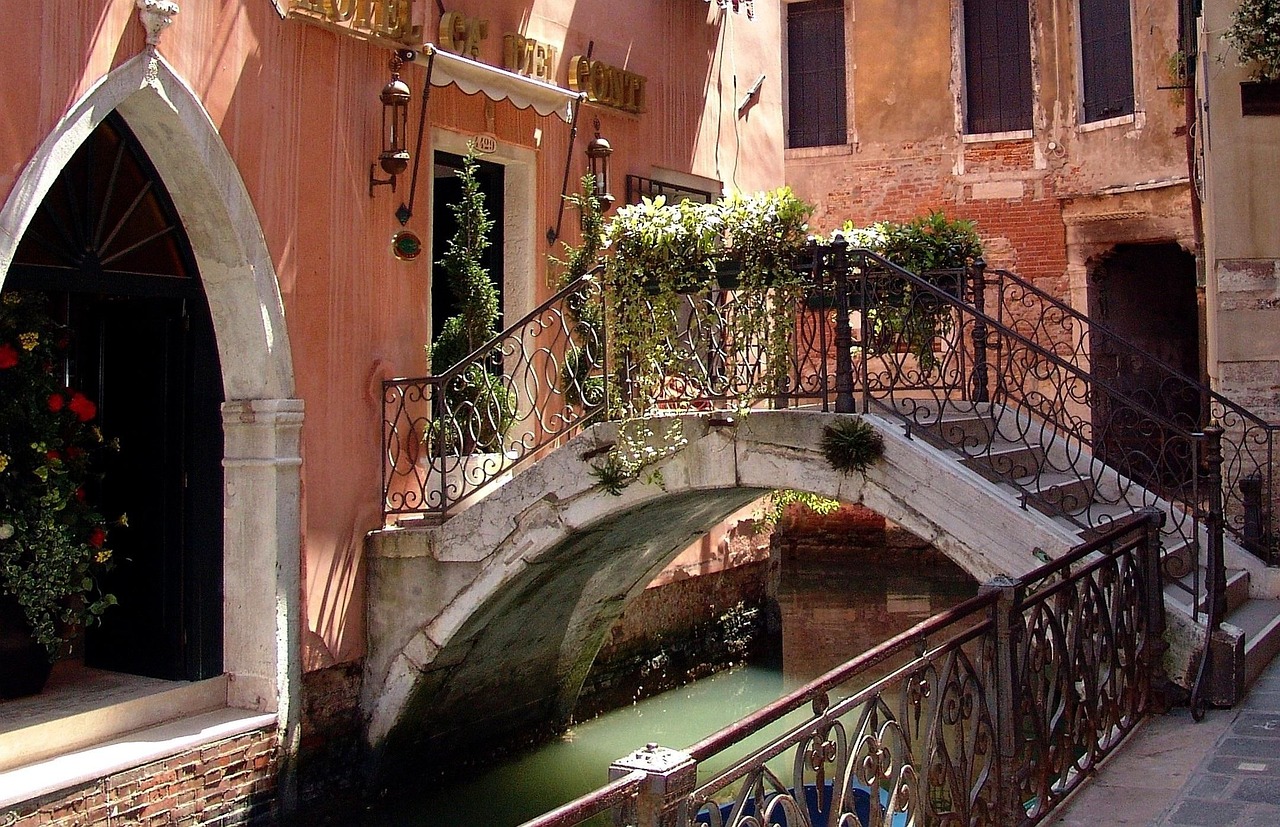
In Venice, hotel distance matters less than the number of bridges between your arrival point and the front door. A room 700 metres away with no canal crossings can be easier than one 300 metres away behind three stepped bridges. Before booking a Venice hotel with luggage, identify the vaporetto stop, station, bus terminal, or boat landing you will actually use, then count every bridge on the final walking route.
This is especially important with a large suitcase, two bags, a stroller, or anyone who cannot comfortably lift luggage. Venice’s bridges are not minor bumps in the pavement. Most involve stairs up one side and down the other, and several crossings in succession can turn a short transfer into the least charming part of your arrival.
Use bridge count, not straight-line distance
Booking sites like to tell you that accommodation is “500 metres from Venezia Santa Lucia” or “five minutes from Rialto.” Neither description tells you how difficult those metres will be.
A more useful test is:
- 0 bridges: excellent for heavy cases, strollers, or an easy arrival.
- 1 bridge: usually reasonable if everyone in your group can lift their own bag.
- 2 to 3 bridges: think carefully if the suitcase is large or your arrival follows a long flight or train journey.
- 4 or more bridges: look for a better vaporetto stop, consider arriving by water taxi, or reconsider the accommodation.
Those are practical thresholds, not official rules. A tiny neighborhood bridge and a large Grand Canal crossing are obviously not equal. The point is to treat bridges as part of the transfer rather than discovering them while holding a 23 kg suitcase.
How to count the bridges before paying for the room
- Find the exact hotel entrance on the map. Do not rely only on the property’s neighborhood name or booking-site distance.
- Choose your real arrival point. That might be Venezia Santa Lucia station, Piazzale Roma, an ACTV vaporetto stop, or an Alilaguna airport-boat stop.
- Display the walking route and zoom in. Trace the route street by street. Each time it crosses a canal, count a bridge.
- Check alternative walking routes. A route that is two minutes longer may eliminate one or two bridges.
- Repeat the calculation for departure. Your best arrival route may not work equally well for a 05:30 departure when boat services are different.
Venetian street vocabulary helps while checking the route. A ponte is a bridge, a calle is a narrow street, and a fondamenta is usually a walkway alongside a canal. An imbarcadero is a boat boarding point. Signs marked Ferrovia point toward Santa Lucia railway station.
Arriving at Santa Lucia: stay on the correct side of the Grand Canal
Step out of Venezia Santa Lucia and the Grand Canal is directly in front of you. This is one of the easiest Venice arrivals to understand, but it is also where travelers make an unnecessary first bridge crossing.
Ponte degli Scalzi, near the station entrance, crosses the Grand Canal toward Santa Croce. Ponte della Costituzione connects the station side of the canal with Piazzale Roma farther west. Both are substantial crossings.
If your accommodation is in Cannaregio on the same side of the Grand Canal as the station, do not cross one of these bridges simply because a map briefly sends you that way. Check whether a same-bank route exists.
If the property is deeper in Venice, taking a vaporetto from Ferrovia can be much easier than hauling cases all the way through the streets. The best choice is not necessarily the stop geographically closest to the hotel. It is the stop with the easiest final walk.
For a broader explanation of the city’s boats and pedestrian routes, see Italy on Foot’s guide to getting around Venice.
Arriving at Piazzale Roma: do not cross the Constitution Bridge automatically
Piazzale Roma is where airport buses, road taxis, and most other road transport hand you over to pedestrian Venice. If your accommodation is in nearby Santa Croce or western Dorsoduro, you may be able to reach it without going anywhere near Santa Lucia station.
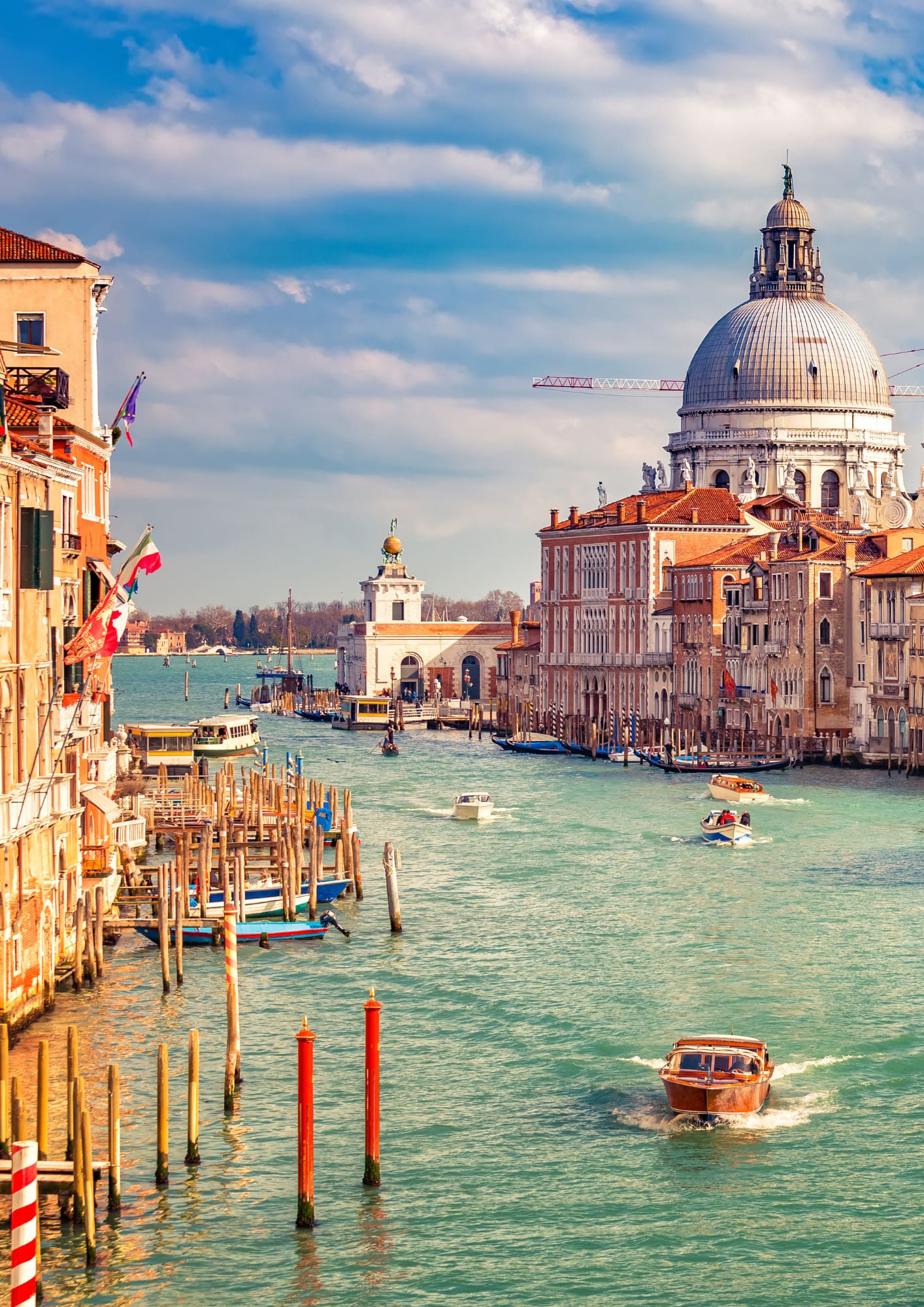
A common mistake is to see the railway station across the canal, cross Ponte della Costituzione with all the luggage, and then discover that the hotel route sends you back toward the side you just left.
Start the bridge count at Piazzale Roma itself. If a vaporetto removes several pedestrian crossings, use the boat rather than assuming walking is simpler because the map shows a modest distance.
Rialto and San Marco: the name of the stop matters
“Near Rialto” is not precise enough for a luggage transfer. Rialto Bridge is itself a large stepped crossing, so being on the wrong bank of the Grand Canal can add exactly the obstacle you were trying to avoid.
ACTV stop names also deserve attention. Rialto and Rialto Mercato, for example, are different stops serving different sides of the central area. Ask the accommodation which one produces the fewest bridge crossings to reception rather than choosing whichever appears first in a route planner.
The San Marco area has the same problem on a larger scale. Several boat stops serve the surrounding waterfront, including stops around San Zaccaria and San Marco. A property described as “near St Mark’s Square” may still involve several small canal crossings once you leave the waterfront.
Ask the hotel these questions before booking
A good property should be able to give a much more useful answer than “we are ten minutes from the station.” Send a short message and ask:
- Which vaporetto stop do you recommend for guests arriving with large suitcases?
- How many bridges are there between that stop and the hotel entrance?
- Is there a slightly longer walking route with fewer bridges?
- Can a private water taxi reach the hotel’s own landing, or what is the nearest usable landing?
- Are there steps between the street entrance and reception?
- Is there an ascensore, or lift, and does it serve every guest-room floor?
The last two questions are easy to overlook. Reaching the front door without a bridge does not help much if reception is up a staircase and the lift begins another level above it. In Italian descriptions, piano terra means ground floor and primo piano means the floor above ground level.
If you are still deciding which part of the city suits your trip, the Italy on Foot guide to where to stay in Venice explains the trade-offs between the main sestieri.
A water taxi is only door-to-door when there is a usable door on the water
A private water taxi can remove a great deal of luggage hauling, but “water taxi to the hotel” does not automatically mean stepping from the boat into reception.
Some hotels have a suitable porta d’acqua, or water entrance. Others do not. A taxi may have to use the nearest practical landing, leaving you with a final walk and perhaps one or more bridges.
Before paying for a private transfer, ask the property: “Can the water taxi stop directly at your hotel?” If the answer is no, ask for the name of the precise landing and count the bridges from there.
This is particularly useful when comparing several accommodations. You can build your Italy itinerary around the transport points you will really use rather than judging a Venice stay solely by walking distance to the main sights.
Public boats have luggage rules too
ACTV vaporetti are normal public transport, not dedicated luggage boats. Under ACTV’s current transport conditions, a passenger with a valid ticket can carry up to three pieces free within specified size limits: two pieces each measuring no more than 120 cm when length, width, and height are added together, plus one piece up to 150 cm. Pieces over the permitted allowance require the appropriate additional ticket, and items exceeding 150 cm in combined dimensions are not permitted. Luggage must not occupy seats or block passageways, and carriage can be refused when crowding creates a safety problem. Check the official ACTV transport conditions before travelling with unusual or numerous bags.
Alilaguna, which operates airport boat services, has different rules. Its current allowance includes one small hand item and one suitcase up to 160 cm in combined dimensions, with an additional charge for extra or larger pieces under its conditions. See the official Alilaguna conditions of transport. Do not assume that an ACTV ticket rule applies to an airport boat run by another operator.
The airport route can change which hotel is easiest
From Marco Polo Airport, a bus to Piazzale Roma and a lagoon boat into Venice create very different final approaches.
If you arrive by bus, count from Piazzale Roma or from the ACTV stop you intend to use afterward. If you take Alilaguna, count from the exact airport-boat stop where your line leaves you. The current network includes central stops such as Guglie, Rialto, San Marco, San Zaccaria and others depending on the line and season.
This can reverse what looks like the obvious hotel choice. A property that is awkward from Santa Lucia may be very simple from Guglie. Another that looks far from Piazzale Roma may have an easy boat approach followed by a flat, zero-bridge walk.
Late arrivals deserve a stricter bridge limit
At 14:00, an extra bridge may merely be annoying. Close to midnight, after waiting for bags and finding that boat frequencies or routes have changed for the evening, the same bridge feels considerably less negotiable.
For a late arrival, check three things before booking: the property’s reception or self-check-in arrangements, the transport service that is actually operating at your expected arrival time, and the walking route from that specific stop.
If your flight can land late, avoid a plan requiring multiple boat changes followed by a long bridge-heavy walk. A prearranged water taxi may be worth considering, but only after confirming where it can leave you.
Strollers and reduced mobility make bridge counting even more important
A stroller has the same basic problem as a suitcase, except you cannot casually drag it up a flight of bridge steps with a sleeping child inside. Travelers with reduced mobility need more than a low bridge count: they need to know whether the specific crossings have permanent ramps or another accessible alternative.
Do not assume that every bridge shown as convenient on a map is step-free. Ask the accommodation for a suitable arrival route and verify current local accessibility information if avoiding stairs is essential.
Do not stop on a bridge to reorganize the bags
Bridges are pedestrian bottlenecks. Venice’s municipal guidance asks people to walk on the right and not stand on bridges. If a suitcase strap breaks, someone needs to check the map, or you simply need a rest, get across the bridge first and move into a wider campo or other space where you are not blocking the flow. The city’s current visitor guidance is available on the Comune di Venezia website.
When the booking is already made and the route looks terrible
If you discover six bridges between your arrival point and reception after the free-cancellation deadline has passed, you still have options.
- Ask the hotel for another route. Staff often know a less obvious approach from a different vaporetto stop.
- Use the boat for the middle of the journey. One extra vaporetto ride may eliminate most of the bridge crossings.
- Ask about a water-taxi landing. Even without a private hotel dock, another nearby landing may leave a much shorter walk.
- Ask whether the property can arrange luggage assistance. Do this in advance rather than assuming a porter will be available when you arrive.
- Leave unnecessary luggage behind temporarily. If check-in timing is the problem, ask the property about deposito bagagli, luggage storage, instead of carrying everything through Venice while sightseeing.
The best Venice accommodation is not necessarily the room closest to Rialto or St Mark’s. On arrival day, a property one vaporetto stop farther away with a zero-bridge walk can be vastly easier. Find the door, find the correct landing, count the bridges, and only then decide whether the location is really convenient.