You enter the Vatican Museums from Viale Vaticano, along the Vatican walls on the north side of Vatican City, about a 15 to 20 minute walk from St. Peter’s Square. It is not in the square and not at the basilica. The nearest metro stops are Ottaviano and Cipro on Line A, bus 49 stops right in front, and there is a taxi rank in the forecourt outside the doors. Book a ticket online, arrive 20 to 30 minutes before your slot, and expect a security check at the entrance before you reach the ticket hall.
In this guide:
- Where the entrance is
- Getting there by metro, bus, tram and taxi
- Tickets and hours
- Lines and security
- Dress code and bags
- Leaving the Vatican Museums
- FAQ
Where are the Vatican Museums?
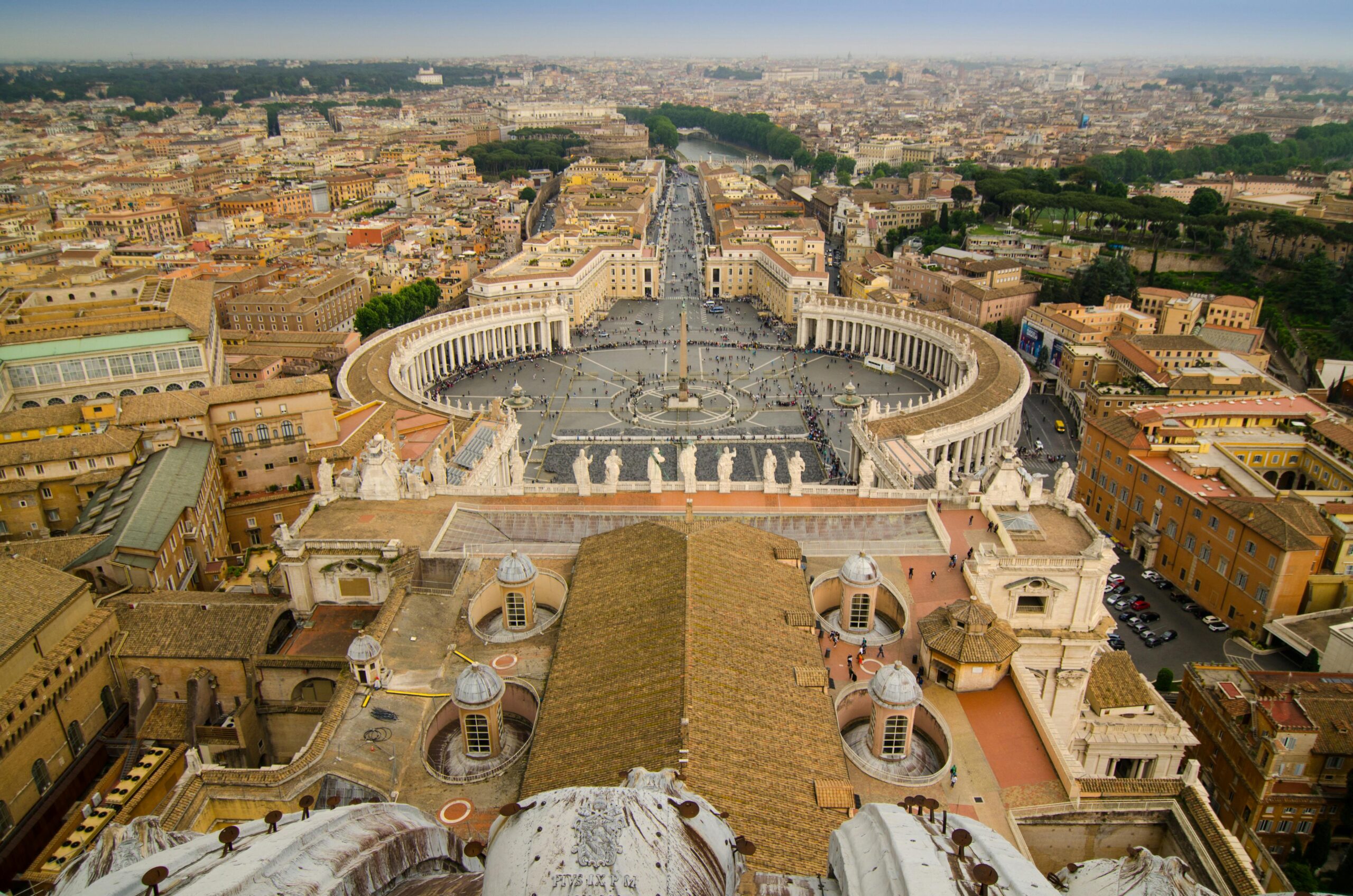
The official address is Viale Vaticano, 00165 Roma. The doors sit in the high walls of Vatican City, just uphill from Piazza del Risorgimento, and the exit hall is right next to the way in. St. Peter’s, by contrast, faces its square on the opposite, southern side of the walls.
That distinction causes most wrong turns. The basilica and the Vatican Museums are close on a map but have completely separate public approaches, so arriving at the square leaves you a walk of roughly a kilometer around the walls. If you have a ticket with a set time, children or limited mobility, aim straight for the Museums side.
Vatican City has several gates, but only one Museums door
Vatican City has other gates, such as the Arch of the Bells beside the basilica and the Sant’Anna gate used by staff and residents, but individual visitors to the Vatican Museums all use the same public way in. Group tours sometimes meet elsewhere and walk over, so check your booking if you are on a guided visit.
How to get to the Vatican Museums
Metro to the Vatican
Take Line A toward Battistini and get off at Ottaviano or Cipro. Both are roughly a 5 to 10 minute walk. From Ottaviano, head toward Piazza del Risorgimento and follow the walls; from Cipro, walk down Via Santamaura. Signs for “Musei Vaticani” are frequent once you are close.
Bus and tram
Bus 49 stops in the square in front of the Vatican Museums. Buses 32, 81 and 982 and tram 19 stop at Piazza del Risorgimento, a few minutes away, and buses 492 and 990 stop at Via Leone IV. A standard Rome ticket is valid for 100 minutes and covers a change between bus and metro.
Taxi drop-off
Tell the driver “Musei Vaticani, ingresso” (the museums’ main door), and add “non Piazza San Pietro” if in doubt. The Vatican Museums list an official taxi rank in the forecourt in front of the building, so a cab can normally take you right there. Avoid saying just “Vaticano” or “San Pietro”, which a driver may reasonably read as the square. If police or traffic controls block the curb, ask for “il più vicino possibile” (as close as possible) on the Museums side of the walls.
Official Rome taxis are white with a TAXI sign on the roof and the Roma Capitale symbol and license number on the door. If the rank is empty when you leave, call the city’s ChiamaTaxi service on 060609.
Walking from St. Peter’s Square
From St. Peter’s Square, follow the walls clockwise via Via di Porta Angelica and Via Leone IV. It takes about 15 to 20 minutes at an easy pace. In summer, allow extra time and carry water, as there is little shade.
Vatican Museums tickets and opening hours
| Ticket | Price |
|---|---|
| Full ticket | €20 (+ €5 booking fee online) |
| Reduced ticket | €10 (+ €5 online) |
| Children under 7, disabled visitors (with companion if needed), ICOM members | Free |
| Last Sunday of the month, 9:00 to 14:00 | Free (last entry 12:30) |
Pre-booked tickets on the official Vatican Museums website cost the €5 fee but let you skip the queue to buy tickets, which can take an hour or more in busy months. Each ticket is valid only for the day issued and cannot be refunded, and your entry time is printed on it. Tours from licensed agencies cost more but include the ticket and a guide.
The Vatican Museums are currently open Monday to Saturday, 8:00 to 20:00, with last entry at 18:00, and visitors must leave the halls 30 minutes before closing. They close on most Sundays and on several religious holidays, including 1 and 6 January, 11 February, 19 March, Easter Monday, 1 May, 29 June, 14 and 15 August, 1 November and 8, 25 and 26 December. Check the official hours page before you go, as special closures happen.
Is the free Sunday worth it?
The last Sunday of the month is free, but you cannot book and the line can stretch for hours, with crowds inside to match. Unless you are on a tight budget, a paid weekday visit with a ticket booked in advance is a far better experience at the Vatican Museums.
Lines and security at the Vatican Museums
When you arrive, staff usually direct visitors into separate lines for online reservations, groups and people still buying tickets. Show your booking on your phone at the entrance and follow the signs rather than joining whichever line looks shortest. Once inside, ticket holders scan their ticket at the turnstiles before the main museum route begins.
Everyone, including people with a reservation, passes through a metal detector just inside the entrance. Booking saves you the ticket line, not the security check, so arrive 20 to 30 minutes early. Visitors with a disability get priority entry without queuing, along with a companion if needed.
Best time to visit
Entry is busiest between 9:00 and 11:00. The first slots in the morning and late afternoon on weekdays are usually the calmest. Tuesday to Thursday tend to be quieter than Monday and Saturday, when the Vatican Museums absorb people who could not visit on Sunday. Wednesdays can be busy around the papal audience in the morning.
Vatican Museums dress code, bags and rules
The dress code applies throughout: no sleeveless or low-cut tops, no shorts or skirts above the knee, and no hats inside. Carry a light scarf or shirt in summer so you are not turned away.
Large bags, suitcases, backpacks, umbrellas (other than small folding ones), tripods and anything sharp must go in the free cloakroom after security. Weapons are forbidden altogether. Photography without flash is allowed in most galleries, but not in the Sistine Chapel, and selfie sticks and drones are banned. The official visitor tips list all the rules.
Wheelchairs and strollers
Most of the route is accessible, and free wheelchairs are available at the cloakroom with an ID document as a deposit, subject to availability. Strollers are allowed, and staff can direct families to lifts. A taxi to the forecourt is the easiest arrival for anyone who wants to minimize walking, as the way in is step-free from the street.
What you see inside the Vatican Museums
The Vatican Museums are not one museum but a chain of more than twenty collections built up by the popes over five centuries, joined by long corridors that end at the Sistine Chapel. Most visitors follow a fairly set route, and knowing the order helps you pace yourself.
Pinacoteca and the Pio-Clementino Museum
Just after the entrance hall, the Pinacoteca (picture gallery) holds works by Giotto, Raphael, Leonardo and Caravaggio, and is often quiet because many people rush past it. The Pio-Clementino Museum, the classical sculpture museum, houses the Laocoön and the Apollo Belvedere around the Octagonal Courtyard, with the Gregorian Egyptian Museum and the Chiaramonti Museum close by.
Gallery of Maps and the Raphael Rooms
From there the route runs through the Gallery of Candelabra, the Gallery of Tapestries and the 120-meter Gallery of Maps, then into the four Raphael Rooms with the School of Athens. These corridors are the busiest part of the visit, so expect slow shuffling in high season.
The Sistine Chapel
The visit builds to the Sistine Chapel, with Michelangelo’s ceiling and Last Judgment. Silence is requested, photography is not allowed, and guards keep the crowd moving, so find a spot along the side benches and take your time. If you have extra energy afterward, the Ethnological Museum (Anima Mundi), the Carriage Pavilion and the Vatican Historical Museum are rarely crowded.
Vatican Museums tours
Guided tours, including early-morning and small-group options, are sold through the official ticket site and by licensed agencies. A tour helps you make sense of the collections and choose a route, though you still pass through the same door and security as everyone else. Audio guides are available inside if you prefer to go at your own pace.
Leaving: the Sistine Chapel and the exit
The visit ends with the Sistine Chapel, the highlight of every Vatican Museums ticket, usually two to three hours after you go in, and the main exit brings you back out next to the entrance. Anything left in the cloakroom must be collected there, at the foot of the famous spiral staircase.
For years, many visitors used a shortcut from the Sistine Chapel straight into St. Peter’s Basilica. The Vatican does not currently advertise this route for individual visitors, so do not plan around it. Instead, walk back around the walls to St. Peter’s Square, which takes about 15 to 20 minutes, and allow time for the separate security line at the basilica.
If the Vatican is one of several fixed bookings on the same day, you can organize the rest of your trip around the set times first and leave realistic buffers between them. Our guide to visiting the Vatican explains how the museums, basilica and gardens fit together.
Making the most of the Sistine Chapel
The Sistine Chapel is the one room everyone wants to see, so it is also the most crowded. A few habits make the experience better:
- Go early or late. The first entry slots and the last two hours before the final entry time have the thinnest numbers in the Sistine Chapel.
- Look up from the sides. The benches along the Sistine Chapel walls give the best view of the ceiling.
- Read up beforehand. Guides cannot talk inside the Sistine Chapel, so tours explain the frescoes in the courtyard first, and it pays to do the same with a book or app.
- Respect the silence. Guards enforce the no-photo rule and ask for quiet every few minutes.
Planning a full day in Vatican City
Many visitors combine the Vatican Museums and St. Peter’s in one day. The simplest plan is to use a morning entry slot for the Museums, have lunch in Prati, then head around the walls to St. Peter’s in the afternoon, when the line there is often shorter. Allow at least five to six hours in total, and more if you want to climb the dome.
Guided tours that cover both sites are popular for a reason: one booking, one meeting point and a guide who handles timing. If you go independently, book the Museums first, as their entry times are the fixed point, and treat St. Peter’s as flexible. Inside Vatican City there are cafés in the Museums’ courtyards, so you do not need to leave for a break during a long visit.
Common mistakes at the Vatican Museums
- Going to St. Peter’s Square: it is the basilica side, not the Vatican Museums.
- Arriving at the exact time on your ticket: security and finding the right line take time.
- Wearing shorts or a sleeveless top: you can be refused entry.
- Bringing a suitcase: it must go in the cloakroom and be collected at the end, which ties you to the same exit.
- Buying from street sellers: unofficial tickets and “skip the line” offers outside the walls are often overpriced.
FAQ
Where exactly do you go in at the Vatican Museums?
On the Museums side of the Vatican walls, near Piazza del Risorgimento, not in St. Peter’s Square. The nearest metro stops are Ottaviano and Cipro on Line A.
Do you need tickets to enter?
Yes. A ticket is needed for entry except on the free last Sunday of the month and for free categories such as children under 7. Booking online avoids the ticket office queue.
How many entrances does Vatican City have?
Several gates exist, but tourists use just two public approaches: St. Peter’s Square for the basilica and the Vatican Museums door on the north side for the collections and the Sistine Chapel.
How long does a visit take?
Plan on two to three hours from entrance to exit for the main route, including the Sistine Chapel, and more if you want to explore the picture gallery or Egyptian rooms in depth.
Can I visit the Vatican Gardens?
Only on a booked tour, such as the open-bus tour (around €37), which runs Monday to Saturday and can be reserved on the official site.