Most traditional food and neighborhood street markets in Italy are morning operations. A market advertised until 13:00 or 14:00 may already look half-finished near closing because traders need time to pack, load vehicles, and clear the public space. For travelers, the safest rule is simple: arrive between about 09:00 and 11:30 if the market itself is an important part of your day.
Italian market closing times are not standardized nationally. The municipality, market type, individual market regulations, and sometimes the day of the week determine what happens. An outdoor produce market may finish at lunch while an indoor hall a few metres away continues through the afternoon.
Why Italian markets often finish around lunchtime
The classic mercato rionale, or neighborhood market, was not designed as an all-day tourist attraction. It is primarily a place for residents to buy fruit, vegetables, meat, fish, cheese, household goods, clothing, and other everyday items.
There is also more to the working day than the hours customers see. Traders can arrive well before sales officially begin to unload, erect stalls, arrange produce, and prepare counters. After selling finishes, everything has to be packed again.
In street markets, the square or road often has to be returned to normal use. Municipal rules can specify separate times for traders to enter, sell, stop selling, and completely vacate the area. Cleaning follows. That is why a busy piazza full of stalls at 10:00 can be almost empty a few hours later.
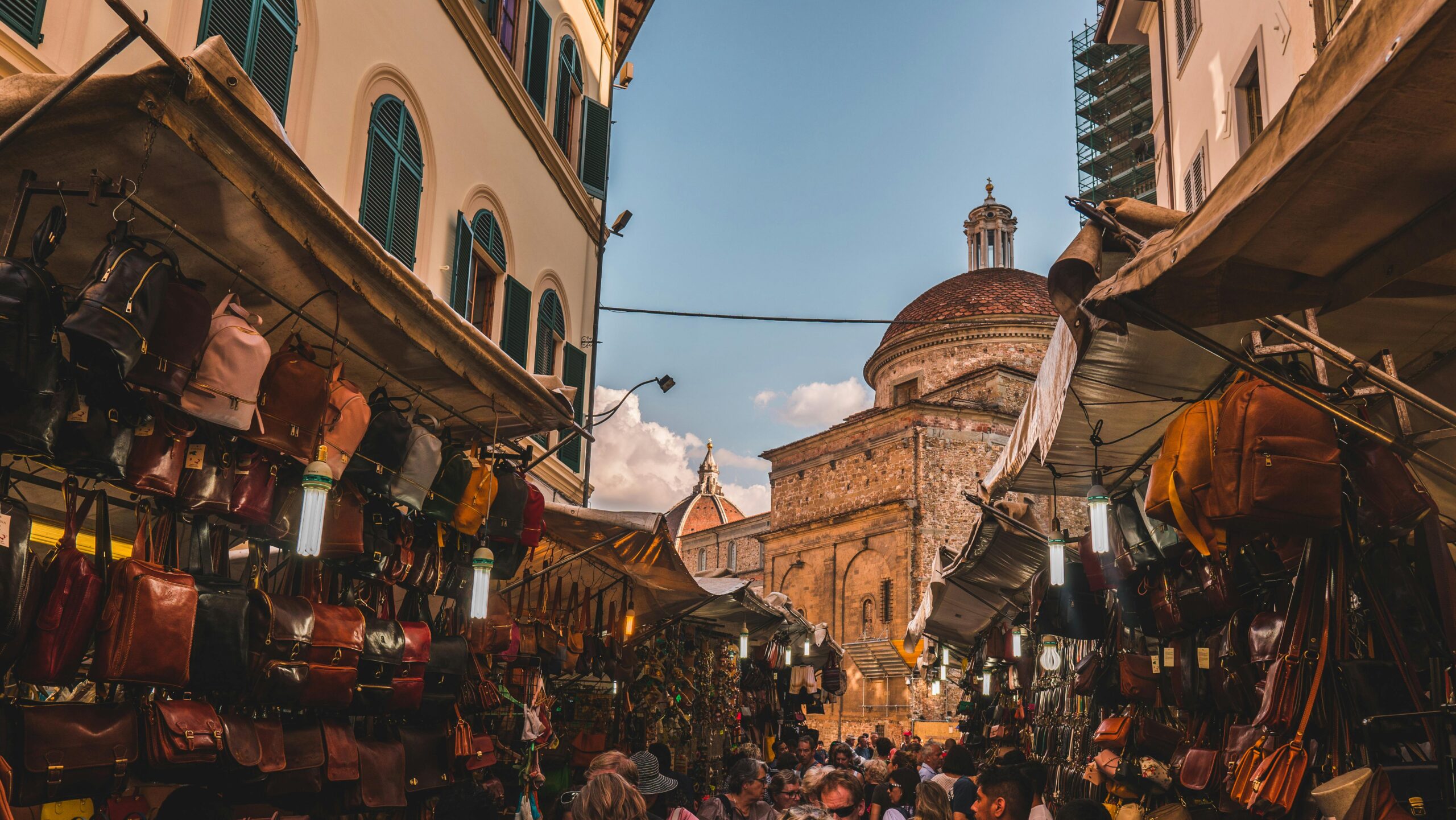
Closing time does not always mean the same thing
When checking a Comune website or market notice, look carefully at what the listed time describes. You may encounter several different deadlines:
- Orario di vendita: the authorized selling hours.
- Orario di fine vendita: the time sales must finish.
- Orario di accesso all’area: when traders may enter the market area to set up.
- Sgombero dell’area: the deadline for removing stalls, vehicles, merchandise, and equipment.
- Orario di apertura: general opening hours, particularly for covered markets.
Florence provides a particularly clear example. In the city’s official market schedule, numerous outdoor neighborhood markets have an 08:00 start for sales, a 14:00 end of sales, and a 15:00 deadline for clearing the area. At the outdoor food section of Sant’Ambrogio, traders can access the area from 05:30, sales run from 07:00 to 14:00, and the area must be cleared by 15:00. The covered Sant’Ambrogio market has its own hours.
You can check the current details in the Comune di Firenze market schedule. If Florence shopping is part of the trip, the Italy on Foot guide to shopping in Florence also explains the main market areas and what you will find there.
How late can you arrive at a morning market?
If a market is officially open until 14:00, arriving at 13:45 is technically very different from arriving at 10:00. You may still find traders selling, but you should not expect the full market experience or every stall to remain fully stocked and arranged.
A useful timing rule is:
- 08:00 to 09:00: good for serious food shopping and getting there before the main late-morning activity.
- 09:00 to 11:30: usually the safest window for travelers who want to browse, photograph the market, compare stalls, and buy food without rushing.
- 11:30 to 13:00: normally still workable at a market closing around 13:00 or 14:00, but some products or individual stalls may already be winding down.
- Final 30 minutes: treat this as shopping time, not sightseeing time. Know what you want and do not assume every trader will remain until the last minute.
Going extremely early is not automatically better. If the official sales start is 08:00, arriving while traders are unloading at 06:45 may simply put you among vans, crates, and half-built stalls.
A 13:00 closing is common, but it is not an Italian rule
Schedules can differ even between markets in the same city. Bologna’s municipal list, for example, gives numerous neighborhood periodic markets an 08:00 to 13:00 schedule. La Piazzola, the large non-food market held on Friday and Saturday, has much longer official hours. The current listings are available through the Comune di Bologna market calendar.
Turin makes the difference especially easy to see. The outdoor Porta Palazzo market currently runs from 07:00 to 14:00 Monday through Friday, with longer Saturday hours according to the City of Turin. Some covered food halls within the same Porta Palazzo market area have later schedules.
So do not search for a single national answer such as “Italian markets close at 1 pm.” Instead, identify the exact market and the exact section you intend to visit.
Outdoor market, covered market and food hall are different things
The Italian word mercato covers several quite different places.
Mercato rionale
A neighborhood market, often focused on fresh food and everyday shopping. It may be indoors, outdoors, or a combination of both. Morning-oriented hours are common.
Mercato settimanale
A weekly market held on a particular weekday. These often occupy a square, street, or car park and disappear completely once traders leave. Search for the town name plus mercato settimanale and the day of the week.
Mercato coperto
A covered market building. Because stalls do not have to dismantle an entire street setup, afternoon opening is more feasible, although the individual market may still keep traditional morning hours.
Mercato contadino
A farmers’ market. These are frequently limited to selected days and may operate for only a few morning hours. Check the organizer rather than assuming the schedule matches the city’s main market.
Food hall or restaurant market
Some historic market buildings now combine traditional retail counters with restaurants, bars, prepared-food stalls, or evening dining. The food hall can remain active long after the fresh produce section has closed. Never use restaurant opening hours as proof that the traditional market stalls will still be trading.
How to read an Italian market listing
A few words make local schedules much easier to decode:
- Lun, Mar, Mer, Gio, Ven, Sab, Dom: Monday through Sunday.
- dal lunedì al sabato: Monday to Saturday.
- giorno di mercato: market day.
- settimanale: weekly.
- giornaliero: daily.
- festivo: public holiday or holiday day.
- prefestivo: the day before a holiday.
- chiuso: closed.
- apertura straordinaria: exceptional or special opening.
- sospeso: suspended.
- trasferito: moved to another location.
For an outdoor weekly market, the Comune or municipality’s commerce pages are usually more useful than a generic map listing. Search for Comune + town name + mercati + orari. For a privately managed covered market, check its own official site as well.
Do not build an afternoon itinerary around a morning market
A common planning mistake is placing a traditional market after lunch because it appears as a permanent attraction on a map. Unlike a museum, the pin does not disappear when the stalls do.
If a market matters to you, put it first in the day. A practical order is market, coffee or early lunch, then the museum, monument, train journey, or longer walk. If you are coordinating several cities, trains, and opening-hour constraints, you can organize the rest of your Italy trip around the time-sensitive stops rather than trying to squeeze those stops into whatever time remains.
Sunday and public holidays need a separate check
There is no nationwide rule saying every Italian market closes on Sunday. Many everyday food markets operate Monday to Saturday, but Sunday antique, craft, farmers’, and special markets are common.
Public holidays are similarly local. A normal market can close, operate exceptionally, move to another date, or follow special hours depending on municipal rules and the event calendar. Florence’s official schedule, for example, specifically lists certain extraordinary holiday market arrangements rather than applying one rule to every date.
If your visit falls on a national holiday, patron saint’s day, Easter period, Christmas period, or another major local event, recheck the official listing shortly beforehand.
What to do if you arrive and the stalls are already packing
First, check whether you have reached the correct part of the market. In a large complex, outdoor stalls may be closing while a covered section remains open nearby.
If traders are actively dismantling their stands, do not try to turn the final minutes into a long browsing session. Ask directly if you want something specific. Useful phrases include “È ancora aperto?” for “Are you still open?” and “Posso comprare questo?” for “Can I buy this?”
For food shopping, the fallback is often a nearby alimentari, bakery, supermarket, butcher, or specialty shop that keeps ordinary retail hours. In Rome, for example, neighborhood markets and supermarkets serve somewhat different purposes, and the Italy on Foot guide to grocery shopping in Rome is useful if you need a backup after the market has closed.
One simple rule prevents most missed-market mornings
Check the exact market rather than assuming all Italian markets follow the same schedule, then aim to arrive at least 90 minutes before the published end of sales. For a traditional market closing at 13:00 or 14:00, late morning is usually the useful window. By early afternoon, the speed with which the stalls vanish is not a sign that you have taken a wrong turn. In many towns, clearing the square is simply part of how the market works.