Puglia in April is one of the best-kept secrets of Italian spring travel. The famous white towns look their cleanest against that first proper blue sky of the year. The coast is warm enough to walk in a t-shirt but too cool for the summer beach crush. The Adriatic parks and Salento trails are at peak walkability before the heat sets in. And the crowds that make Puglia difficult in July and August simply are not there yet. If you are planning a puglia in april trip, the best structure is white-town mornings paired with coast-walk afternoons, built around a trio of small towns in the Itria Valley and the protected coastal parks of Brindisi, Otranto, and Santa Maria di Leuca. Here is how to build it.
The Short Version
Best white-town trio: Ostuni (the White City, anchor), Locorotondo (circular hilltop plan), Cisternino (intimate maze of alleys). For coast walks: Torre Guaceto reserve (trekking, birdwatching), Dune Costiere park (easy 15 km route), Otranto-Leuca park (Palascìa lighthouse to Torre Sant’Emiliano). April temperatures 16-21°C, sea too cold for swimming but perfect for walking. Skip Alberobello if you want fewer crowds — do a quick morning stop rather than a base.
Why April Is the Smartest Month for Puglia
Puglia’s official tourism line confirms the obvious: summer is high season, with July and August bringing the heat, crowds, and premium pricing that define the region’s busiest months. Spring and autumn are the shoulder windows when the mild climate and light visitor numbers give you the best version of Puglia. April is firmly inside that window.
Temperature-wise, April averages 16-21°C during the day, with nights in the 10-13°C range. That is perfect for walking, enough for outdoor dining, and still too cool for swimming (the Adriatic does not really warm up until late May). For travelers coming from colder northern European climates, April Puglia feels like a true spring: warmer than home, but not yet the punishing summer heat that will hit in July.
The practical benefits are significant. White-town hotels are still at shoulder rates. Restaurants have tables without reservations. The Via Traiana and the coast paths are quiet. You can drive country roads without tour-bus convoys. And the almond groves, olive trees, and wildflower fields of the Itria Valley are at their most photogenic just before summer dust sets in.
The White-Town Trio: Ostuni, Locorotondo, Cisternino
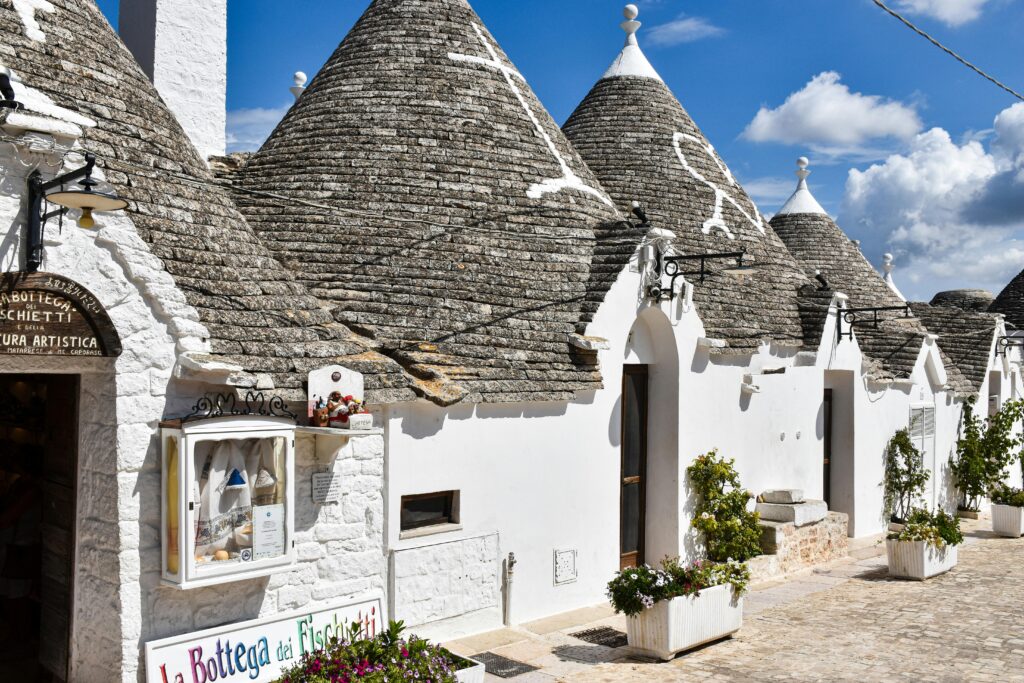
Alberobello gets the headlines because of its trulli (cone-roofed stone houses), but for fewer crowds and a better white-town experience, Ostuni, Locorotondo, and Cisternino are the stronger trio. All three sit in or near the Itria Valley, all three have lime-painted old towns, and all three are close enough to each other that you can base in one and day-trip to the others easily.
Ostuni: The Anchor
Ostuni is the largest and best-known of the white towns, and it earns its “White City” nickname honestly. The old town is built on a hill with houses painted bright lime-white, producing a skyline visible from kilometers away across the olive groves. The Adriatic coast sits just 7 kilometers away, which means you can combine an ostuni spring travel morning with a coast afternoon without any logistical stress.
The historic center is built for walking: narrow lanes, staircase alleys, small piazzas with views that open suddenly between buildings. The 15th-century Cathedral is worth visiting for its rose window and frescoes. Side streets host artisan workshops, wine bars, and trattorias serving orecchiette with cime di rapa and local olive oils. An afternoon is enough to see the core; two days let you explore more thoroughly and settle into the rhythm.
Locorotondo: The Circular One
Locorotondo gets its name from its near-perfect circular hilltop plan: the old town is organized in concentric rings around a central point. Walking the outer ring gives you uninterrupted views of the Itria Valley; walking inward takes you through the whitewashed historic core. The ring shape is genuinely unusual in Italian village planning and the effect is striking.
The town is one of the “most beautiful villages of Italy” (I Borghi più belli d’Italia) and it shows: clean streets, well-kept white facades, and distinctive cummerse (steep-pitched roofs on small trullo-style buildings found locally). It is compact enough to walk in 2 hours but has good wine bars and small restaurants that reward a longer visit. The local Locorotondo DOC white wine is excellent and usually available for tasting.
Cisternino: The Intimate One
Cisternino is the smallest and the most rewarding for travelers who want the quietest version of a white town. The historic center is a maze of narrow alleys, bright staircases, and tiny piazzas tucked between whitewashed walls. It is the kind of place where you turn a corner and find yourself somewhere you did not expect, and where every third house seems to have a grandmother sweeping her doorstep at breakfast.
Cisternino is famous for its butcher-shop restaurants (fornelli pronti): you choose meat from a butcher’s counter, it is grilled on a wood fire, and you eat it at a small table nearby with wine. This is not a tourist gimmick; it is a genuine local tradition that happens to be delicious and unusually affordable. The town makes an excellent dinner destination even if you are staying elsewhere.
Coast Walks: The Afternoon Pairing
The strongest structure for a Puglia spring day is white-town morning plus coast walk afternoon. Three protected coastal areas are especially worth your time in April when the temperature is ideal for trekking.
Torre Guaceto Nature Reserve
Torre Guaceto sits on the Adriatic coast near Brindisi, about 40 minutes from Ostuni. The reserve protects a stretch of dunes, wetlands, Mediterranean scrub, and fossil dunes, with a 16th-century watchtower as the focal point. Trails through the reserve are well-marked, flat to gently rolling, and suitable for any fitness level.
April is excellent here for birdwatching as migratory species move through the wetlands. The coastal trails connect the inland wetland areas to the beach, with informational boards explaining the fossil dune formations and local plant communities. Allow 2 to 3 hours for a meaningful walk. Pack water; some stretches have no shade.
Dune Costiere Park
The Parco delle Dune Costiere stretches along the coast between Ostuni and Fasano, protecting a rare combination of dunes, wetlands, and the monumental olive grove (ulivi monumentali) inland. The park publishes a concrete hiking product: an easy 15 km walk taking 2 to 5 hours depending on your pace, covering dunes, wetlands, and optional extensions into the fossil dune area and the monumental olive plain.
The walk is entirely flat and suitable for casual walkers. The mix of coastal and inland scenery is unusual: you can start on the beach, walk through wetlands, and end among thousand-year-old olive trees in a single route. The monumental olive grove includes trees with trunks large enough that several people can stand inside the hollow bases.
Otranto to Santa Maria di Leuca
The southernmost coastal walks are in the Otranto-Leuca park in Salento. Otranto’s spring travel page recommends the scenic trek from Palascìa Lighthouse (the easternmost point of Italy) to Torre Sant’Emiliano, a coastal path with dramatic cliff views and wildflowers in April.
Further south toward Santa Maria di Leuca, short accessible routes include the 3 km Tratturi del Ciolo and the Cipolliane path (both around an hour, both suitable for casual walkers). For serious hikers, the much longer South East Track covers multiple days of coastal walking. This is where Salento’s landscape earns its nickname as “Italy’s Finisterre”: windswept, dramatic, and distinctly different from the northern Itria Valley.
Building a 5-Day Puglia Itinerary April Trip
A strong spring structure: day 1 arrive Brindisi or Bari, transfer to Ostuni, afternoon exploration. Day 2 Ostuni morning + Torre Guaceto afternoon. Day 3 Locorotondo morning + Dune Costiere afternoon. Day 4 Cisternino morning + drive south to Otranto, settle in. Day 5 Otranto morning + Palascìa-Torre Sant’Emiliano walk. Optional 6th day: Santa Maria di Leuca and return.
This pattern balances three white-town mornings with three different coast walks, uses one base change (Ostuni to Otranto) to cover the geography, and builds in enough time to actually slow down and eat well. If you are using a walking-focused Italy itinerary, Puglia is especially rewarding because the infrastructure (paths, local buses, small-town logistics) is better than many visitors expect.
What to Skip (or Minimize) in April
Alberobello april is the obvious name on every Puglia list, but its trullo-heavy old town is also the region’s most crowded destination even in April, as day-tripping tour groups from cruise ships at Bari make it their signature stop. A 2-hour morning visit is enough. Do not base your trip there.
The Gargano peninsula (in the far north, near the Foresta Umbra) is beautiful but less accessible by public transport and better suited to trips of 10+ days. For a focused April trip, the Itria Valley plus Salento gives you the best balance of quality and logistics.
Beaches in the traditional sunbathing sense are not yet the attraction. The water is too cold for swimming, beach clubs are not open, and beachside restaurants are mostly still closed. Treat the coast as walking terrain, not as a beach vacation, and April Puglia shines.
Puglia in april gives you the version of this region that justifies its reputation: white towns clean in the spring light, coastal parks alive with migratory birds and wildflowers, olive groves green before the summer dust. Pair white-town mornings with coast-walk afternoons, skip the tourist-heavy spots, and build in time to actually eat lunch somewhere you found by accident. That is the Puglia April rewards.