Sicily in April is the version of the island that actually lets you look at it. The baroque towns of the Val di Noto catch the low spring sun on their honey-colored stone. The hills are green. The air is mild rather than the heavy mid-summer heat. And the crowds that define Taormina, Syracuse, and the Valley of the Temples in peak season are still light enough that you can walk through the famous places without fighting for space. For a sicily in april trip, the best structure is a Val di Noto baroque spine: five small-to-medium towns rebuilt after the 1693 earthquake in a burst of architectural creativity that UNESCO calls the final flowering of Baroque art in Europe. Festivals add optional timing bonuses, but the spine is what carries the trip.
The Short Version
Baroque spine: Noto (capital of Sicilian Baroque), Modica (chocolate + dramatic stairways), Ragusa Ibla (cinematic walking town), Scicli (UNESCO baroque + nature), plus Palazzolo Acreide or Caltagirone (majolica 142-step staircase) as a fifth stop. Spring festivals to catch: Modica’s Vasa Vasa and Scicli’s U Gioia at Easter; Cerda’s artichoke festival April 25; Piana degli Albanesi cannoli festival. NOTE: Noto’s Flower Festival is May 15-19, 2026, NOT April. April temperatures 16-20°C, ideal for walking.
Why April Is the Right Month for Baroque Sicily
Sicily in spring is quieter, greener, and more authentic than the summer version most tourists experience. April temperatures run 16-20°C in the south and slightly cooler in the interior hills where several of the Val di Noto towns sit. The agricultural landscape is at its most vivid: green wheat fields, almond trees past blossom but still fresh, wildflowers along roadsides, and the dry summer landscape that will dominate July and August has not yet taken over.
Crowd-wise, April is a transition. The very early April and mid-April weeks are genuinely quiet; Easter week and the April 25 Liberation Day bridge bring Italian domestic travel that adds atmosphere without the international tour-group pressure of July. If you can avoid the specific holiday bridges, early-to-mid-April gives you the quietest and most relaxed version of the Val di Noto.
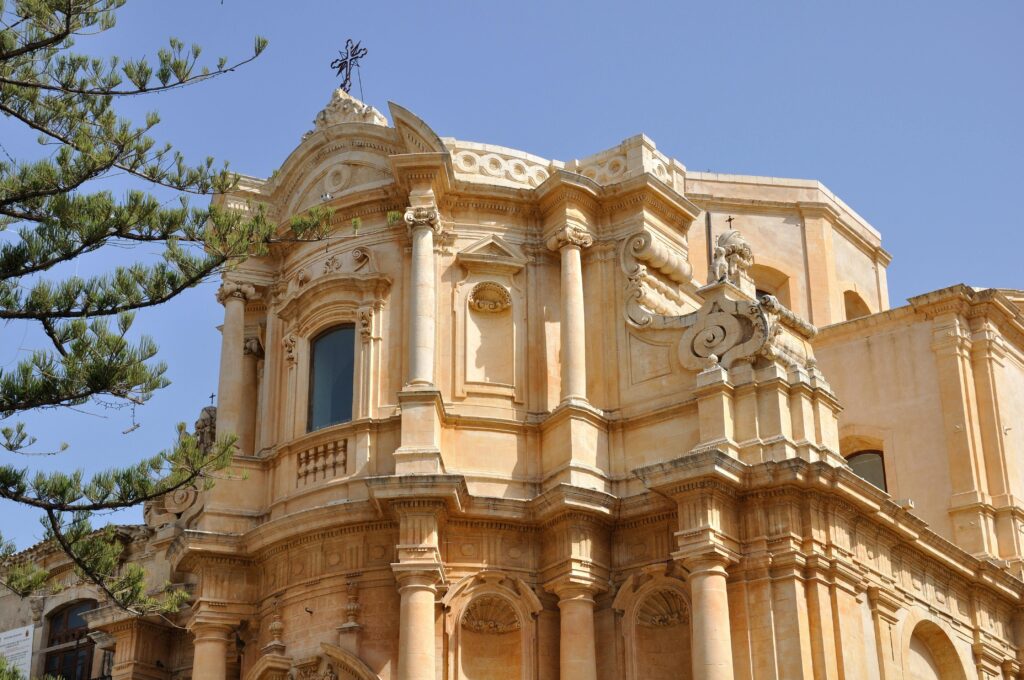
The light is the real reason April works for baroque architecture. These towns were rebuilt after the 1693 earthquake in a coordinated burst of creativity between about 1700 and 1770, using local limestone that takes on a distinctive golden color in direct sunlight. April’s low-angle sun, clearer air, and lighter humidity produce the best photographic conditions of the year. Midday shots that would wash out in August hold their detail in April.
The Val di Noto Baroque Spine
Noto: The Capital
Noto is the obvious anchor because it is, by official designation, the capital of Sicilian Baroque. The town’s main corso runs through a sequence of baroque churches, palaces, and piazzas built in coordinated golden limestone, with the Cathedral of San Nicolò as the centerpiece. The town is compact enough to walk end-to-end in an hour but rewards a full day of slower exploration.
The morning and late afternoon hours are when the limestone glows most beautifully. Walk the Corso Vittorio Emanuele from Porta Reale to Piazza XVI Maggio. Visit the Cathedral and climb, if possible, the nearby Church of Montevergine for the rooftop view. Eat a long lunch at one of the small trattorias off the main corso. Explore the side streets in the afternoon when tour groups have cycled through.
A very important 2026 note: Noto’s famous Flower Festival (Infiorata) is scheduled for May 15-19, 2026, not in April. If you specifically want to see the flower-carpet art installations, you need to come in mid-May. The April version of Noto is still beautiful, just without the Infiorata artwork.
Modica: Chocolate and Stairways
Modica sits in a dramatic ravine, with its baroque architecture stacked up hillsides and connected by monumental stairways. The town’s 300-plus-step climb up to San Giorgio Cathedral is one of the iconic walks in the Val di Noto, ending at a baroque church that stands out even against the competition in this region.
Modica’s second signature is its artisan chocolate, made using a cold-process technique traced to Aztec Mexico via Spanish colonial influence. Antica Dolceria Bonajuto is the historic benchmark chocolate shop and worth visiting for tasting. The chocolate itself is gritty and aromatic, very different from standard European chocolate, and the shop sells everything from basic bars to elaborate gift boxes.
Allow a full day for Modica. Morning climb up to San Giorgio, lunch at one of the restaurants serving Modican specialties (try cioccolato modicano with a bit of chili for the traditional flavor), afternoon exploring the lower town and the Corso Umberto I.
Ragusa Ibla: The Cinematic Town
Ragusa Ibla is the most visually overwhelming of the Val di Noto towns. Split from the newer Ragusa Superiore by a deep valley, Ibla is the older half: a tangle of uphill alleys, panoramic stairways, noble palaces, and at its heart the Cathedral of San Giorgio, one of the most photographed baroque churches in Italy. The town has been a fixture of Italian television and film (including the Montalbano detective series), which draws a steady but manageable stream of visitors.
The best walking approach is to enter from above (Ragusa Superiore side), descend the Santa Maria delle Scale stairway for the classic view, explore Ibla’s core, and climb back up via the scenic Corso Mazzini or the stairs. Plan on 4 to 5 hours, and consider staying overnight to experience Ibla in the evening when day-trippers leave and the lighting on the baroque stone is at its most dramatic.
Scicli: Baroque Plus Nature
Scicli is the best places sicily april option for travelers who want baroque architecture plus a natural-landscape dimension. The town is UNESCO-listed for its baroque core but also sits near the Vendicari Nature Reserve and the Cava d’Ispica canyon, both of which work as half-day walking extensions. The town itself is smaller and quieter than Noto or Ragusa, which makes it a good relaxed overnight stop.
Scicli’s baroque highlights include the Via Mormino Penna, a single street lined with exceptional baroque palaces, and the Church of San Matteo on the hill above town with panoramic views. The town’s Holy Week procession is distinctive (see festivals section below). For nature, the nearby Cava d’Ispica includes rock-cut dwellings, byzantine chapels, and walking paths through a limestone canyon.
Caltagirone or Palazzolo Acreide: The Fifth Stop
For a fifth Val di Noto town, you have two distinct options. Caltagirone is the visual choice: the 142-step majolica staircase of Santa Maria del Monte, with each step decorated in hand-painted ceramic tiles, is one of the most photographed public artworks in southern Italy. The town’s ceramic tradition dates to Arab rule in the 10th century and continues in active workshops today. For travelers interested in crafts and visual culture, Caltagirone is irreplaceable.
Palazzolo Acreide is the quieter, village-scale option. Smaller than the other towns, it retains a genuine everyday rhythm that busier spots have lost. It has its own baroque architecture, a well-preserved Greek theater on the outskirts (the ancient city of Akrai), and a calmer atmosphere that appeals to travelers wanting one truly low-key stop in the sequence. Choose based on your priorities: Caltagirone for visual wow, Palazzolo Acreide for quiet.
Spring Festivals That Add to the Trip
April festivals in Sicily range from religious processions to food celebrations. If your dates align, these add atmosphere without reshaping the trip.
Modica’s Vasa Vasa is a distinctive Easter Sunday ritual in which a statue of the risen Christ is carried through town to meet a statue of the Madonna, with the moment of “kiss” (vasa vasa in Sicilian) drawing huge local crowds. Scicli’s U Gioia is a similar Easter Sunday procession with its own local traditions. Both are highlights of the Val di Noto Holy Week calendar.
For food festivals, the ricotta cannoli festival in Piana degli Albanesi (near Palermo) is usually held in April and celebrates Sicily’s most famous pastry with hours of tastings, demonstrations, and music. Cerda’s artichoke festival on April 25 (Liberation Day) fills the small Madonie town with stalls featuring the local artichoke variety in every possible preparation. The ricotta-and-cheese festival in Vizzini at the end of April celebrates the pastoral traditions of central-eastern Sicily.
The Regional Day of Sicily’s Trails and Paths took place on April 12, 2026, coordinating guided walks across the island. If you are planning future April trips, watch for the 2027 date, which is usually announced a few weeks ahead.
Building a 7-Day Sicily Spring Itinerary
A strong spring spine using four baroque towns: day 1 arrive Catania, transfer to Noto. Day 2 Noto full-day exploration. Day 3 Noto to Modica, Modica afternoon/evening. Day 4 Modica + Scicli day trip (they are close). Day 5 Modica to Ragusa Ibla, afternoon and evening in Ibla. Day 6 Ibla morning + Caltagirone on the return north. Day 7 depart Catania.
If you are using Italy walking itineraries, the Val di Noto is particularly rewarding because most travel is town-based walking with short drives between them. The daily structure (morning exploration, long lunch, afternoon side-trip or second town) fits naturally with how the baroque towns actually work.
Practical Notes for April
The Val di Noto is best explored by car. Public transport between the towns exists but is infrequent, and the flexibility of driving lets you adjust based on weather, lighting, and energy. Rental cars from Catania airport are the standard starting point.
Restaurants and accommodation are fully operational in April, with shoulder-season pricing. Book 3-4 weeks ahead for the April 25 weekend and any Easter-adjacent dates; weekday accommodation can often be confirmed much closer to the date.
Sicily in april is not about a dramatic festival or a single highlight event. It is about walking through golden baroque towns in comfortable weather, eating unusually well, and having the famous places quiet enough to actually experience. Build the trip around the baroque spine, let festivals be bonuses rather than anchors, and the island rewards you with its best self.