A family photoshoot in Venice does not need to involve crossing several bridges or walking between famous landmarks. For families with toddlers, strollers or grandparents, a 30- to 60-minute session in one small area is often enough for a varied collection of portraits. St. Mark’s Square, the San Marco waterfront and parts of the Zattere offer attractive backgrounds without requiring a long walking route, provided you approach them from the correct waterbus stop.
When booking a family photographer Venice visitors should ask for the exact meeting point, walking distance, number of bridges and planned locations before paying. A route described as “Rialto, San Marco and hidden canals” may sound manageable but involve considerable walking and stairs. The most useful arrangement is usually one accessible area where the photographer can create different backgrounds while your family remains comfortable.
Why walking distance matters more in Venice
Venice has hundreds of bridges, many with steps. A location that appears only 300 metres away on a map may require several bridge crossings, while a slightly more distant waterfront can be reached directly by vaporetto and explored along a level path.
This makes Venice different from cities where a taxi can drop your family beside almost any attraction. In the historic center, the closest practical drop-off point is often a waterbus landing or an authorized private water-taxi pier.
For a family photoshoot, ask the photographer to plan around four details:
- Distance: How far everyone will actually walk during the session.
- Bridges: How many crossings involve steps, and whether ramps are available.
- Rest opportunities: Whether there are suitable places to pause if a child or older relative becomes tired.
- Access: How you will reach the first location from your hotel or nearest vaporetto stop.
Do not assume that an advertised one-hour photography session means one hour spent standing in front of the camera. Walking between locations, managing children and organizing group portraits can take a considerable portion of the booked time.
Which locations work best without long walks?
The most practical locations provide several photographic backgrounds within a compact area. The following options are useful starting points, although the exact route and number of bridges must be confirmed for your family.
St. Mark’s Square: recognizable Venice photographs in one place
Piazza San Marco is one of the easiest places to create a varied collection of recognizable Venice photographs without traveling between neighborhoods.
Within the square and adjacent Piazzetta, a photographer can use St. Mark’s Basilica, the Campanile, the arcades, the Doge’s Palace exterior and views toward the lagoon as backgrounds.
For a family with younger children, the advantage is that much of the photography can happen within one open area. Children can walk a short distance between compositions rather than repeatedly climbing bridges.
However, getting to the square matters. If you arrive by vaporetto at S. Marco Vallaresso, the City of Venice identifies an accessible approach through Calle Vallaresso and, where necessary, a route via Calle Salvadago that avoids the steps associated with the raised arcade area.
The city’s official accessible San Marco itinerary explains the route in detail.
St. Mark’s Square is usually busiest during the middle of the day. Early morning can provide more space for family portraits, although the area is never guaranteed to be empty.
If you have a stroller, ask the photographer to remain within the square and adjacent waterfront rather than automatically continuing toward Rialto or crossing several bridges for canal photographs.
Riva degli Schiavoni: open waterfront views and room for family groups
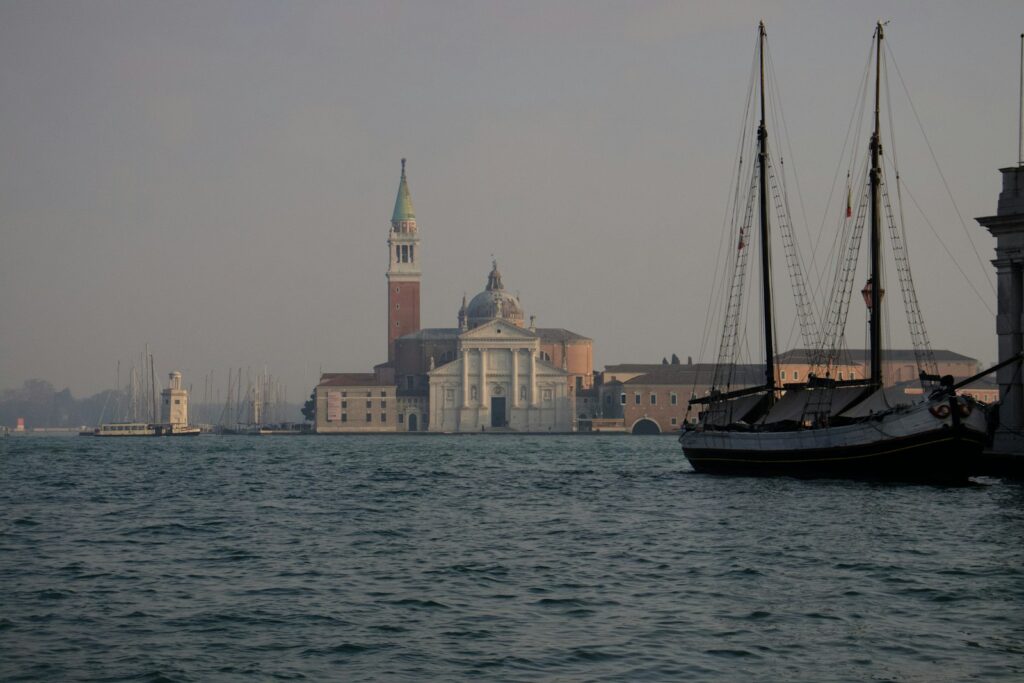
Riva degli Schiavoni is the broad waterfront promenade extending east from the Doge’s Palace area. It offers views across St. Mark’s Basin toward San Giorgio Maggiore, moored boats and Venice’s historic waterfront buildings.
The promenade is useful for families because it provides more open space than many narrow canalside streets. A photographer can take formal group portraits, individual photographs of the children and natural walking photographs without constantly repositioning everyone in a small alley.
For a short session, consider meeting near the San Zaccaria waterbus landings and using a nearby section of the waterfront.
However, the promenade is not continuously step-free along its entire length. Bridges such as Ponte della Paglia, Ponte del Vin and Ponte della Pietà interrupt parts of the route, and some have temporary or seasonal accessibility measures.
If your family cannot manage steps, ask the photographer to identify a suitable section that does not require crossing those bridges. Do not assume that every bridge ramp shown in an older photograph will be installed on your travel date.
The waterfront can also become crowded with passengers arriving from waterbuses and sightseeing boats. For younger children, choose a position safely away from the unprotected edges and active boarding areas.
Zattere: a practical choice for strollers and grandparents
The Zattere promenade in Dorsoduro faces the broad Giudecca Canal. It offers waterfront scenery, old buildings, passing boats and views across to Giudecca.
It can work especially well for families who want photographs with Venetian water and architecture while avoiding the busiest parts of San Marco.
A useful starting point is the San Basilio vaporetto stop. The City of Venice identifies the route along the Zattere from San Basilio toward Ponte Longo as accessible without crossing a barrier along that initial stretch.
This means a photographer can plan a short walk, use several positions along the waterfront and return toward the same stop without needing to include a stepped bridge.
Farther east, the promenade crosses bridges that have historically received temporary accessibility ramps during parts of the year. The municipality’s Zattere accessibility guidance describes these arrangements.
For families requiring a completely step-free route, ask the photographer to remain on a confirmed accessible stretch rather than trying to cover the entire waterfront.
The Zattere is also exposed to wind and sun. During warmer months, a morning or late-afternoon session may be more comfortable than midday photography.
Sant’Elena and eastern Castello: space for children to move
The eastern part of Castello, particularly the Sant’Elena area, provides a different setting from Venice’s busiest landmarks.
Here you will find green spaces, broad paths, residential streets and lagoon views. These can be useful for families with toddlers who want to move naturally rather than stand still for a series of posed photographs.
The City of Venice identifies eastern Castello as one of its accessible areas, with relatively level routes around Sant’Elena and the nearby gardens.
You can approach using the Sant’Elena vaporetto stop, subject to the service operating on your date. The official Castello Est accessibility itinerary explains the area’s paths and access.
This is a useful option if your priorities are family interactions, green backgrounds and a gentler walking pace.
However, it may be less suitable if you want every photograph to contain an instantly recognizable Venetian landmark. Ask the photographer to show examples from the area so you understand the backgrounds.
Quiet canals in Dorsoduro or Cannaregio
Smaller canals can provide photographs with bridges, old building façades, moored boats and narrow Venetian streets.
Dorsoduro and Cannaregio both contain areas where a photographer can create several compositions without traveling far.
The main caution is that a small canal route may involve more bridge crossings than a waterfront session. Even an apparently short loop can include several sets of steps.
If you want quiet canal photographs, ask the photographer to select one short stretch and use nearby angles rather than moving from bridge to bridge.
For example, a photographer might arrange several portraits along one fondamenta, a walkway beside a canal, using a bridge in the background without asking the family to cross it.
This can be a good arrangement for school-age children who enjoy walking and exploring. For a stroller or wheelchair, the actual approach route should be confirmed before booking.
Which famous photography locations involve difficult walking?
Some of Venice’s most photographed landmarks are less practical when avoiding steps is a priority.
Rialto Bridge
Rialto offers attractive Grand Canal views, but the bridge itself has stairways and is frequently crowded.
Families carrying a stroller may find the crossing tiring, especially when several people stop on the stairs to take photographs.
If you want Rialto in the background, ask for a viewpoint from a suitable nearby waterfront position rather than assuming you must stand on top of the bridge.
Confirm which side of the Grand Canal you need to reach. Arriving at the wrong side can create an unnecessary crossing.
Accademia Bridge
Ponte dell’Accademia provides one of Venice’s recognizable Grand Canal views toward Santa Maria della Salute.
However, its stepped approaches make it less convenient for families needing a continuous level route.
A photographer may be able to suggest a nearby viewpoint or another Dorsoduro setting that avoids climbing the bridge.
Do not book a supposedly stroller-friendly route based solely on a photograph taken from its highest point.
Several small bridges in one session
A route advertised as a walk through hidden canals may look attractive in a portfolio. In practice, repeated bridge crossings can become difficult with toddlers, a double stroller or older relatives.
Ask whether the photographs could be created using bridges as backgrounds without actually crossing every one.
Venice provides plenty of visual variety within individual streets and squares. It is often unnecessary to cover several different neighborhoods to produce a varied family gallery.
How long should a family photoshoot last?
The right duration depends on the age of the youngest participant, the number of people and how much moving between locations is required.
Thirty minutes: babies, toddlers and one location
A 30-minute session is often sufficient for a small family with a baby or toddler. It can provide a few posed photographs of everyone together, portraits of the children and natural photographs of the family interacting.
The best arrangement is to meet directly at the photography location. Avoid using part of the short appointment for a long walk from the nearest waterbus stop.
Thirty minutes leaves little room for changing clothes or moving to another district.
Ask the photographer to prioritize the essential group portraits early, before the children become tired or distracted.
Sixty minutes: a useful balance for most families
An hour is often a suitable duration for families with school-age children and grandparents, particularly when the route stays within one area.
It allows more time for different family combinations, candid photographs and short breaks.
For example, a session could remain within St. Mark’s Square and its nearby waterfront, or use several positions along an appropriate section of the Zattere.
Do not assume that a one-hour session should cover three famous landmarks. A photographer who spends ten minutes walking between locations has ten fewer minutes available for taking photographs.
Ninety minutes: larger families or a relaxed pace
A 90-minute session can be useful for a multigenerational group wanting photographs of several family units.
The extra time can allow grandparents to sit between portraits, children to have a snack or parents to attend to a baby.
However, the purpose should be to make the session more comfortable, rather than forcing the group to walk farther.
Ask whether you can use one or two nearby locations without crossing several bridges.
Two hours or longer
Longer sessions are more suitable for families with older children, larger groups requiring many combinations or visitors who specifically want several distinct backgrounds.
Two hours may be unnecessary for a family with a two-year-old who becomes tired after 30 minutes.
If you want photographs in both San Marco and Dorsoduro, ask how the group will travel between them and whether transport time is included in the booked session.
For families avoiding long walks, two shorter sessions on different days may be more comfortable than one extended route across Venice.
Ask for a walking route, not just a list of locations
One of the most useful things a photographer can provide before booking is a simple description of the route, including where it begins, where it finishes and the number of bridges involved.
For example, a family with a stroller could request a 30-minute session along the Zattere, beginning near San Basilio and remaining on the same accessible waterfront section. Another family might prefer a 45-minute session around St. Mark’s Square, using the square, Piazzetta and nearby lagoon views.
A family with older children could arrange a one-hour session in Cannaregio, stopping along one or two neighboring canals without walking across the district.
Ask the photographer to confirm:
- The exact meeting point.
- The nearest vaporetto stop.
- The total expected walking distance.
- How many bridges must be crossed.
- Whether any bridges have steps or temporary ramps.
- Where the most important portraits will be taken.
- Whether the session returns to the starting point.
- How the route can be shortened if necessary.
If the photographer cannot describe the walking route before payment, ask for more information. A statement such as “easy walk around Venice” is not specific enough when your family needs to avoid stairs.
How to reach the photography location with a stroller or wheelchair
Venice’s public waterbus system can make a short-walk photoshoot much easier. The key is reaching the correct part of the city by boat rather than trying to walk across several islands connected by bridges.
For example, a family staying near Venezia Santa Lucia station could take a suitable ACTV service toward San Marco rather than walking the entire distance with a stroller.
The City of Venice publishes accessible itineraries, and its official tourism service provides information through the Accessible Venice service. This includes routes designed for wheelchair users, people with reduced mobility and families with pushchairs.
The city’s MoveIn accessibility resource also identifies barriers such as bridges, steps and ramps.
However, accessible routes require current verification. Some bridges have temporary ramps, and high or low water may affect boarding conditions at particular piers.
For a family with a wheelchair user, confirm every stage of the journey: boarding the waterbus, leaving the correct landing and reaching the intended photography position. The fact that a vaporetto is accessible does not mean every street beyond its landing is step-free.
Should you arrange a private water taxi?
A private water taxi can reduce walking when your family is staying far from the selected photography location.
However, it may be expensive relative to a short photoshoot, and it does not automatically provide door-to-door access.
Some hotels have private water entrances, while others require guests to walk to a suitable public landing. The water level and the boat’s dimensions can also affect which docks are usable.
If you are considering a taxi to avoid bridges, ask the photographer and operator to agree on the exact drop-off point before making payment.
A water taxi may be unnecessary when a public vaporetto stops close to a suitable photography area. For many families, choosing a shorter route near an appropriate ACTV landing is simpler than arranging extra transportation.
Photography with babies and toddlers
Babies and toddlers usually determine the practical pace of the session. A photographer who regularly works with families should be comfortable adjusting activities when a child needs feeding, changing or a short break.
Choose a time when your child is normally rested and comfortable. An empty St. Mark’s Square at sunrise may provide attractive photographs, but it may be a poor choice for a toddler who normally sleeps until 8 a.m.
Ask whether the photographer is comfortable taking photographs of children in a stroller, being carried or walking with their parents.
Some of the most useful family photographs may involve natural interactions, such as a parent holding a baby beside a canal or siblings walking together along a broad promenade.
Bring a small bag containing:
- Water and age-appropriate snacks.
- Nappies and changing supplies if needed.
- A familiar comfort item.
- A spare outfit for younger children.
- A cloth for wiping faces and hands.
- Any essential medication.
If your child needs a stroller for the entire session, make that clear. A photographer should not plan a route that requires folding and carrying it over several bridges unless you have agreed that this is manageable.
Photography with grandparents and larger families
A multigenerational family session needs more planning than a photoshoot involving two parents and one child.
Give the photographer the total number of participants, their approximate ages and any mobility limitations before selecting a location.
For a group of eight or ten people, a wide waterfront or open square may be easier than a narrow bridge. The photographer needs enough distance to frame everyone without forcing the group to stand in a busy pedestrian route.
Agree on the most important combinations in advance. These might include:
- Everyone together.
- Grandparents with all the grandchildren.
- Each individual household.
- Siblings and cousins together.
- Grandparents as a couple.
- Each parent with their children.
- Individual portraits of the children.
Take the most important group photographs near the beginning, while everyone is comfortable and attentive. The remaining time can be used for smaller combinations and more relaxed photographs.
If someone cannot stand for long, ask the photographer to identify suitable seating or another way to arrange portraits comfortably. A family portrait does not require every participant to stand in the same position.
What if the children do not want to pose?
Not every child enjoys formal photography, and a long series of instructions can become frustrating for younger participants.
Ask the photographer how they work with children who are shy, restless or reluctant to look at the camera.
A family session can include walking hand in hand, sharing a quiet moment beside the water or letting siblings interact naturally. These activities can be photographed without requiring everyone to maintain a fixed pose.
For children who need encouragement, short activities may be more productive than repeated requests to smile. A photographer familiar with family sessions should know how to work around changes in attention and mood.
However, the waterfront requires supervision. Children should not be encouraged to run close to canal edges, climb parapets or sit in unsafe positions for a photograph.
If a child becomes tired or upset, ask the photographer to prioritize the remaining essential portraits. Continuing for another 30 minutes may produce less useful photographs than ending the session comfortably.
What time of day is best for family photographs?
Venice offers attractive light throughout the day, but crowds, temperatures and children’s routines influence the best appointment time.
Early morning
Morning often provides more space at famous landmarks such as St. Mark’s Square and along the waterfront.
The light can also be softer than it is at midday, particularly before direct sun reaches narrow streets and creates strong contrasts.
However, sunrise can be very early in summer. Before booking, consider the time needed for everyone to wake up, dress, eat breakfast and reach the location.
For a family with a baby or toddler, a slightly busier session at a comfortable hour may work better than requiring everyone to be ready before dawn.
Late afternoon
Late afternoon can be suitable for waterfront photography, particularly around the Zattere or other areas where the photographer can use lower natural light.
However, some children become tired or hungry toward the end of a sightseeing day.
If you choose an afternoon session, avoid spending the previous several hours walking between major attractions. Allow time to return to your accommodation or have a break beforehand.
Midday
Midday photography can be challenging during summer because of heat and direct sunlight.
Bright light may cause children to squint, while dark shadows from buildings can create uneven lighting.
If midday is your only available time, ask the photographer to select suitable shaded areas and avoid long periods of standing in direct sun.
A shorter session in a compact location may be more comfortable than an extended route during the hottest hours.
What happens if it rains or there is acqua alta?
Rain can affect a family photoshoot in several ways. Children may become cold, clothing can become wet and stone pavements can be slippery.
Some photographers continue in light rain, using covered arcades or other sheltered locations. Others offer rescheduling when conditions prevent the agreed session.
For a family with young children, ask whether the photographer will move the booking rather than expecting everyone to work in heavy rain.
Venice also experiences seasonal high water, known as acqua alta. St. Mark’s Square is one of the city’s lowest areas and can be affected before higher parts of Venice.
The City of Venice’s high-water information explains how tidal levels affect different areas and how temporary pedestrian routes may be used.
High water can make a normally suitable photography location impractical, especially with strollers or mobility equipment.
Ask for a backup location that can be reached safely without adding a long walk. If rain or high water is forecast, check the conditions with the photographer before leaving your accommodation.
A covered location is not automatically suitable. It must provide enough space for the family and allow the photographer to work without obstructing other people.
What should everyone wear?
Comfortable footwear is particularly important in Venice. Even a short session may involve uneven paving, wet stone or a few steps.
Avoid asking children to wear unfamiliar shoes that are difficult to walk in. Shoes that cause discomfort can affect the entire session.
For family clothing, choose colors that look good together without requiring everyone to wear identical outfits.
A simple combination of complementary colors can help the group appear coordinated in photographs. Large logos and busy patterns may draw attention away from people’s faces, although the final choice should reflect how your family normally dresses.
For young children, bring a spare outfit in case of a spill. For babies, a small blanket can be useful during cooler sessions.
In colder months, consider whether you want photographs with coats or whether there will be somewhere practical to remove them temporarily.
Outfit changes generally take more time than expected. For a 30- or 60-minute family session, one outfit is usually sufficient unless your accommodation is directly beside the location.
Should you include a gondola in the photoshoot?
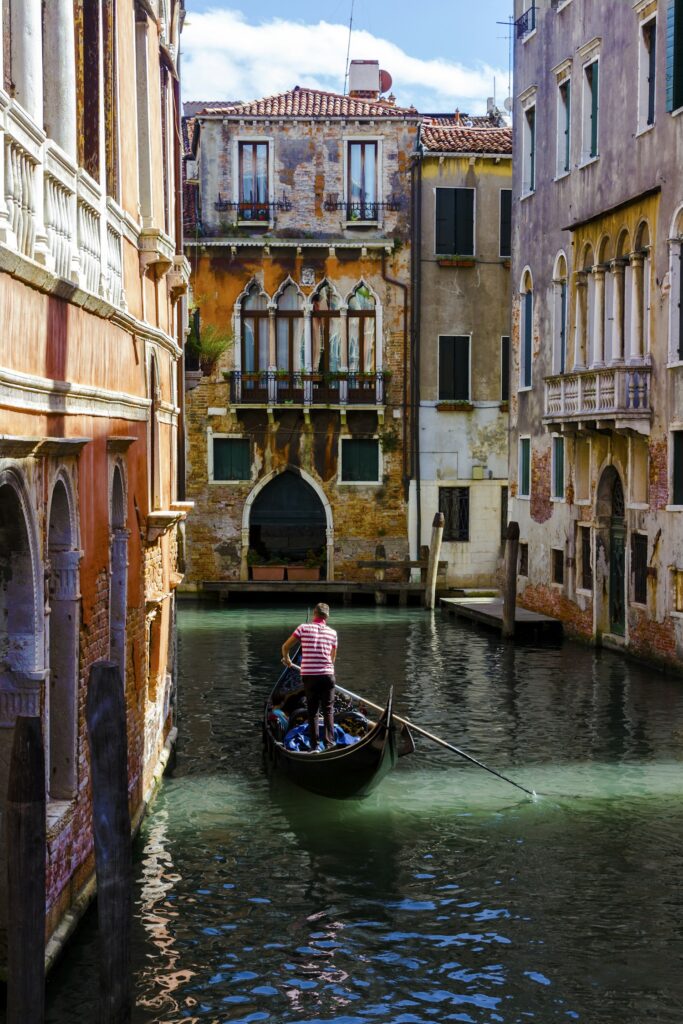
A gondola can provide a different background, but it adds another activity and several practical considerations.
Under Venice’s currently published official tariffs, an ordinary private gondola ride costs €90 for 30 minutes during the day or €110 for 35 minutes after 7 p.m.
The ordinary gondola capacity is five passengers. If your photographer rides with the family, they count toward that passenger limit.
For a large family, one gondola may not accommodate everyone. You may need two boats or a different photography arrangement.
Boarding also requires stepping into the vessel, with the height difference changing according to the water level.
For grandparents, toddlers or someone using mobility equipment, a gondola may add more complications than it solves.
Ask whether the photographer would work aboard the gondola, take photographs from a bridge or arrange another position. Those methods require different coordination.
If the goal is to minimize walking, photographing your family beside moored gondolas or against a canal may be simpler than adding a boat ride.
How much does a family photographer in Venice cost?
Prices vary by session duration, photographer experience, group size, editing and delivery.
Current published examples show how much the arrangements can differ.
As of October 2026, Smiler’s St. Mark’s Square photography packages advertise €99 for 30 minutes with 20 edited photographs and up to six participants, or €169 for 60 minutes with 50 edited photographs and up to twelve participants. The listed delivery period is 48 hours.
Another local family photography service, Carlo & Liz of CB Photographer Venice, advertises 30-minute family sessions from €300 and 60-minute sessions from €400, with professionally edited high-resolution photographs delivered within 24 to 48 hours under its published arrangements.
These are prices from individual services and should not be treated as a standard Venice photography rate. One offer may use a fixed location and a prearranged package, while another provides more personal consultation or a customized route.
For a family of six, compare the total group price rather than assuming that the photographer charges the same rate for every participant.
Also check whether the package’s maximum group size includes babies, children and grandparents. A larger group may require a different package even when the session duration remains the same.
What should the photography package include?
The number of photographs taken during the session is normally greater than the number of finished images delivered.
A clear booking should specify:
- Duration: The actual photography time and whether walking counts toward it.
- Group size: The number of adults and children included.
- Locations: The agreed area and whether the photographer helps plan an accessible route.
- Edited images: The minimum number of photographs you will receive.
- Retouching: Whether basic editing or more extensive changes are included.
- High-resolution downloads: Whether the files are suitable for printing.
- Delivery time: When the gallery will be ready.
- Gallery access: Whether the photographs are delivered through a private online link.
- Usage rights: Whether you may print and share the photographs for personal purposes.
- Extra charges: Additional people, locations, transport, express delivery or purchased images.
Ask whether you will receive all usable photographs or a selected number. The phrase “unlimited photos” can refer to photographs taken rather than edited images delivered.
If a particular portrait is important, such as grandparents with all the grandchildren, list it before the session. Receiving 50 photographs is less useful if the one family combination you wanted was never captured.
Can the photographer publish photographs of your children?
Some photographers use images from family sessions in their portfolios, websites and social media accounts.
Before booking, ask whether promotional use is included in the agreement and whether you can decline it.
Some providers use different pricing when clients authorize portfolio publication, so check whether keeping all photographs private changes the quote.
Also ask whether the online gallery is password-protected, how long it remains available and whether the photographer will seek permission before publishing identifiable photographs of your children.
If you want the pictures used only for personal purposes, request that arrangement in writing before paying.
Are permits required for professional family photographs?
Venice has municipal procedures governing professional photographic and video productions in public spaces.
The city’s Sportello Cinema, updated in April 2026, distinguishes light productions involving up to six people, minimal equipment and no interference with public circulation from larger or more disruptive activities.
Under the published framework, qualifying light productions may require prior communication at least ten days beforehand. Larger productions or those affecting public space may require formal authorization, generally requested at least thirty days in advance.
The applicability to an ordinary commissioned family portrait session should be checked for the specific activity. Professional photography, personal snapshots and larger commercial productions do not necessarily fall under identical procedures.
Ask the photographer whether any municipal notification, permit or location permission applies and who is responsible for arranging it.
Do not assume you can set up large lighting stands, block a bridge or occupy a waterfront area simply because you have paid a professional photographer.
For most family sessions, keeping the equipment compact and respecting pedestrian access makes the arrangements simpler.
How to arrange the photoshoot around your hotel
One of the easiest ways to reduce walking is to select a photography location close to your accommodation or to the nearest suitable vaporetto stop.
If your hotel is in San Marco, the square or nearby waterfront may be convenient. If you are staying in Dorsoduro, a section of the Zattere could save you from crossing the city for a 30-minute appointment.
However, the hotel district alone does not establish which route is easiest. An address near a landmark may still have a stepped bridge between the building and the photography location.
Ask the photographer to confirm the route from your actual hotel or nearest accessible landing. Our guide to accessible Venice without bridges explains how to use waterbuses to connect separate accessible areas without attempting long walks across the historic center.
If your family is arriving by water taxi, remember that an accommodation’s private dock may not always be usable, depending on the tide and boat type. Arrange the photoshoot based on where you can actually arrive, rather than the hotel’s position on a map.
Planning the photoshoot around sightseeing
A short photography session can fit into an ordinary sightseeing day, but it should not be added after several exhausting hours of walking.
For younger children, a morning appointment before major attractions can work well. If your children normally need a midday nap, avoid arranging photographs during that period.
For a family staying near St. Mark’s Square, you could take photographs before visiting the area independently. A session along the Zattere might work before lunch or a relaxed afternoon in Dorsoduro.
You can use the Italy on Foot trip planner to organize the photography appointment alongside sightseeing, meals and transport. Record the exact meeting location and the time you need to leave your accommodation, rather than only the advertised start time.
For practical information about public boats and walking routes, see the Italy on Foot guide to getting around Venice.
Try to leave some flexibility afterward. Children may need to eat, change clothes or return to the hotel before continuing the day.
What if someone becomes ill or the family is late?
Photographers use different booking and rescheduling policies. Some offer free changes until a specified deadline, while others require a non-refundable deposit or charge for short-notice cancellations.
Some fixed-location photography packages currently advertise free cancellation until 24 hours before the session. Independent photographers may have different terms, particularly during busy travel periods.
Ask what happens if a child becomes ill, your waterbus is delayed or the family arrives late at the meeting point.
A photographer with another appointment afterward may be unable to extend your session. Arriving 20 minutes late for a 30-minute booking could leave very little time for useful photographs.
Also establish what happens if the photographer becomes unavailable. Will another photographer be assigned, can you review their portfolio and are you entitled to decline the replacement?
If the weather is unsuitable, ask whether the session can be moved to another day during your visit or whether an alternative location will be used.
For a short trip, booking photography early in your stay gives you more opportunity to reschedule if necessary.
How to compare photographers before booking
Look specifically for family photography examples rather than relying only on wedding, honeymoon or proposal portfolios.
A photographer experienced with adult couples may create attractive portraits but have limited experience organizing a large group or working with toddlers.
Ask to see examples involving children of similar ages and family groups of a comparable size.
Look at whether the photographs include natural interactions, portraits of everyone together and smaller family combinations.
It is also useful to review photographs taken in the neighborhood you intend to use. Someone familiar with the San Marco waterfront may already know practical places to stand without obstructing pedestrians or moving between bridges.
Ask whether the photographer works with a fixed route or can adjust the session according to your family’s mobility and preferences.
If the photographer cannot identify a realistic short-walk location, consider another provider or a simpler single-location package.
When you may not need a professional photographer
A professional session is most useful when you want the entire family photographed together, edited portraits suitable for printing or a particular collection of photographs that everyone can appear in.
If you only want a few vacation photographs, you may not need a paid session.
You can take family photographs in St. Mark’s Square or along other public waterfronts using your own camera or phone, while respecting local rules and other visitors.
For a family with limited time, a shorter paid session may provide enough photographs without reserving a full hour or more.
Do not assume that a longer, more expensive booking will automatically produce better photographs of young children. The location, timing and photographer’s ability to work comfortably with your family may matter more.
Questions to ask before booking a family photographer in Venice
Send the photographer your preferred date, accommodation area, number and ages of participants, and any stroller or mobility requirements. Then obtain written confirmation of the details that will affect your family.
- Do you regularly photograph families with children of these ages?
- Can you share examples from recent family sessions?
- Which location would you suggest if we want to minimize walking?
- Can we remain within one small area throughout the session?
- What is the exact meeting point?
- Which vaporetto stop should we use?
- How far will we walk in total?
- How many bridges will we need to cross?
- Do any bridges have steps or temporary ramps?
- Can the route accommodate our stroller or wheelchair?
- Are there suitable opportunities for grandparents to sit and rest?
- Can the session be shortened if a child becomes tired?
- What is the most suitable time for our children’s ages and routine?
- How many adults and children are included in the quoted price?
- Can we request particular photographs of grandparents, parents, siblings and individual children?
- How long is the actual photography session?
- Does walking between locations count toward that time?
- How many edited photographs are guaranteed?
- Will we receive full-resolution files suitable for printing?
- When will the finished gallery be delivered?
- Can we keep our family’s photographs private and decline promotional use?
- Are any photography permits or notifications required for the planned activity?
- What is the total price, including any additional people, locations or delivery charges?
- What happens if it rains or high water affects the location?
- Can the appointment be rescheduled if a child becomes ill?
- What happens if we arrive late or the assigned photographer becomes unavailable?
- What are the deposit, cancellation and refund conditions?
For most families with toddlers, a 30-minute session at one accessible location is a sensible starting point. Families with older children or grandparents may prefer 60 minutes, particularly when they want several group combinations.
Before paying, ask for a route description identifying the exact waterbus stop, walking distance and bridge crossings. A photographer who can produce several different backgrounds within one small area will usually make the experience easier for a family than someone planning an ambitious route across Venice. Confirm those details along with the image count, delivery deadline and cancellation policy, so the session works for the people in your group rather than simply following a standard sightseeing route.